
I come from a long line of plucky widows. My great-grandmother, Eliza Jane, lost her husband when she was thirty-three and was left with eight children to raise on her own. Another great-grandmother, Hannah, was widowed at age forty-three (five children). My Grandma Lula became a widow at thirty-nine (six children). And my own mother, Evelyn, was thirty-eight when my father died, leaving her with seven children. None of these women ever remarried.
If something had to be done, my indomitable mother just did it. Even as a younger woman, this can-do attitude was a hallmark of her personality. In 1948, when she was twenty years old, the Church temporarily lowered the age at which women could serve missions from twenty-three to twenty-one. My mother decided she wanted to go on a mission—and that she would leave as soon after her birthday as possible. Her parents were dubious. It was rare for women to serve missions at this time. But my mother persisted and entered the mission home on October 10, 1949, paving the way not only for her younger sister to serve a mission a few years later, but also all three of her future daughters, the majority of her nieces, and many of her granddaughters.
My mother had fervent testimony of the restored gospel, but it rankled her that men made all the decisions in the Church. I’d never seen her so upset as when the new meetinghouse our little rural ward community had worked so hard to raise the money to build didn’t include basic, commonsense features—especially in the kitchen and women’s bathrooms. “If ever they’d think to ask a woman, maybe they could get it right!”
It’s a frustration many of us still share. Still, there is cause for hope for those of us who look forward to the day when women in the Church will be fully heard, valued, and empowered. Forward movement is evident. It’s a beautiful thing to be part of a church that believes in progress, growth, and ongoing revelation.
In 2024, Sister J. Anette Dennis of the Relief Society General Presidency unwittingly created a firestorm when she said: “There is no other religious organization in the world, that I know of, that has so broadly given power and authority to women.” This statement elicited over 17,000 online comments, most from LDS women pushing back against this claim.
Granted, the Church teaches that “when men and women go to the temple, they are both endowed with the same power, which is priesthood power.”[1] But what does this mean, in a practical sense? How does this translate into lived experience? Because the reality is that many women in the Church don’t feel at all empowered, as evidenced by the majority of those 17,000 comments.
In examining these questions and others related to the empowerment (or disempowerment) of Latter-day Saint women, it’s important to distinguish between individual experience, institutional practice/policy, and doctrine. Finally, no discussion of this topic would be complete without an exploration of possible ways forward.
Individual Experience
Individual experience can vary widely and is always dependent on a number of variables, including the agency of all those involved. While it is true that many women in the Church feel as empowered as they want to be (see, for example, this op-ed in the Deseret News), it is also true that many do not.[2] It is critical that we not discount anyone’s personal experience.
My own experience with practical service in the Church has been largely positive. The male leaders with whom I have served have been genuinely respectful of my opinions, perspectives, and leadership. I know other women, though, who have had very painful and demeaning experiences with local leaders in the Church and who have felt routinely overlooked and undervalued.
Regardless of anyone’s personal experience, the broader, systemic issues cannot be overlooked.
Institutional Practice and Policy
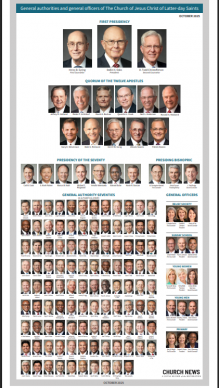
LDS Church Leadership 2026
One can love the restored gospel and be firmly committed to it and still recognize that the institutional church is decidedly patriarchal. A quick glance at the Church’s leadership chart bears this out. Only 9 of the 145 top leaders of the Church are women, and all their decisions must be approved by the men who oversee them.
In the Church, only men can be bishops, stake presidents, mission presidents, temple presidents, area authorities, and general authorities; only men hold priesthood keys (or “the right to preside over and direct the Church within a jurisdiction”); and, with the exception of certain temple ordinances (an exception it behooves us all to consider more carefully), only men can officiate in priesthood ordinances.[3]
What this means, in effect, is that not only do men have the final decision-making power over every aspect of Church policy and governance, but they also hold all sacerdotal power. This, in concert with the massive gender imbalance in leadership, also means that male perspectives are often the only ones considered—a genuine problem for a church whose membership is at least half female.
When decisions affecting individuals, groups, and entire institutions are made only by a select group, and when that select group excludes women, everyone suffers. Both women and men are diminished under such a system.
Doctrine
What about doctrine? The Church clearly teaches that men and women are equal in value and “stand in a position of absolute equality before the Lord.”[4] And yet many women in the Church continue to feel like (and be treated like) second-class citizens.
The Church also teaches that both men and women are endowed with priesthood power in the temple. And yet women are not ordained to priesthood offices. It is not clear whether this exclusion is doctrinal or merely based on tradition. As articulated in the Gospel Topics Essays (under the heading: Early Latter-day Saint Understandings of Priesthood): “Early Latter-day Saints likewise thought of priesthood primarily in terms of ordination to ecclesiastical office and authority to preach and perform religious rites. As in most other Christian denominations during this era, Latter-day Saint men alone held priesthood offices, served formal proselytizing missions, and performed ordinances like baptism and blessing the sacrament of the Lord’s Supper.”
The question of why women are not ordained to offices in the priesthood appears to be one that will require additional revelation. Is it because men and women have different roles in God’s plan (the explanation most commonly given)? Is it because women innately possess a different power (the priestesshood, if you will) that does not require ordination, as some have suggested? If so, what does this mean in practical terms? Or is it an exclusion based on historical precedent and nothing else? Only additional light and knowledge can provide the answer. But whatever the case, as long as those who occupy the key administrative roles and hold the ultimate decision-making power in the Church are always and only men, true gender equality will remain elusive.
The disconnect between doctrine and practice with regard to women is both puzzling and painful to many in the Church. If women “stand in a position of absolute equality before the Lord,” why are our voices so often not sought or heard? Why do we not have equal representation in the spaces where decisions that affect us all are made?
A Way Forward
Though currently excluded from the positions that serve as the formal repositories of traditional power and authority in the institutional organization, it is critical that women in the Church not feel powerless. We have access to divine power through our faith in Jesus Christ, through the gift of the Holy Ghost, and through our temple covenants and endowment. We need not wait for permission to use that power for good. God urges us all to be “anxiously engaged” and to do “many things of [our] own free will” because “the power is in [us]” (Doctrine and Covenants 58: 26-28). We can be active agents for righteous change.
There are numerous examples throughout the history of the Church of women who have claimed this power and used their moral authority to make their voices heard and their influence felt. Typically, they have done this in one of two ways: 1) by working within the structure of the institution, or 2) by doing independent work outside the institution.
Examples of the first are abundant: Eliza R. Snow helped solidify the doctrine of a Heavenly Mother when she penned the words to the poem/hymn “O My Father” (originally entitled “Invocation”). Sarah Granger Kimball’s idea for the formation of a sewing society to aid those working on the Nauvoo temple led to the organization of the Relief Society. In 1878, Aurelia Spencer Roberts was concerned about the lack of moral training for the little boys in Farmington, Utah. She later recorded: “A fire seemed to burn within me . . . The query then arose in my mind could there not be an organization for little boys wherein they could be taught everything good and how to behave.”[5] She took this idea to Eliza R. Snow, General President of the Relief Society, who took it to President John Taylor. Soon the Primary Association of the Church of Jesus Christ of Latter-day Saints was formed and placed under the supervision of President Eliza R. Snow.
Granted, examples like this of women influencing Church doctrine, organization, and policy were more common at a time when the Church was smaller and more localized. Still, more recent innovations such as greater equity in the budgets for YW and YM programs and the 2019 change to the YW theme were undoubtedly influenced by women.
A second but often unrecognized way that women have affected positive change is by doing independent work outside the institution while remaining supportive of the doctrines and leaders of the Church. Examples include women-led organizations such as the Mormon Women’s History Initiative, Mormon Women for Ethical Government (MWEG), the LDS Women Project, Meetinghouse Mosaic, and others. The influence of these groups is often less easily discerned, but is nevertheless very real. When these organizations bring to light compelling new research, make public statements on ethical issues, share the stories of a wide variety of LDS women from around the world, or otherwise shine a light on Church practices and members, the official institution can be moved to acknowledge new research and scholarship, make inspired statements of its own, recognize and celebrate the diversity of experiences and perspectives within its membership, and seek additional light.
My mother and grandmothers would be thrilled with many of the recent changes regarding women and the Church. But there is still work to be done. Thankfully, we belong to a church that believes in ongoing revelation and is fully committed to progress and growth.
Sharlee Mullins Glenn is an author, advocate, and community organizer. She founded Mormon Women for Ethical Government (MWEG) in 2017 and served as its first executive director. She currently serves as Relief Society president in her ward, volunteers with a number of humanitarian organizations, and sits on the boards of several nonprofit organizations.
[1] M. Russell Ballard. “Men and Women and Priesthood Power.” BYU Devotional Address. August, 2013.
[2] Caralynn Clark. “As a Latter-day Saint woman, I’ve been heard, valued, and empowered for decades.” Deseret News. March 21, 2024.
[3] “Priesthood Keys.” Ensign. May 2012.
[4] “Equality of Men and Women.” Eternal Marriage Student Manual.
[5] Aurelia Spencer Rogers. “Life Sketches of Orson Spencer and others: and history of Primary Work.”