
Trina Caudle is a writer, editor, and Interviews Editor for the LDS Women Project whose faith journey has increasingly centered on relationships, compassion, and authentic ministering.
To begin, share briefly about your personal journey that got you here today.
I grew up in Oregon as the oldest of eight kids, and we were raised in the Church. From the time I was a kid, I always wanted to be a writer about real life things. Nonfiction, especially biography and memoir, is my favorite thing to read and I love to learn about people. When I was ten, I read a book by Erma Bombeck, who was the original mommy blogger before mommy blogs existed. She was a newspaper columnist starting in 1965, writing about funny things that happened as a parent. Growing up in the LDS world, I was “of course” going to be a mom, but hey look, I could also be a writer.
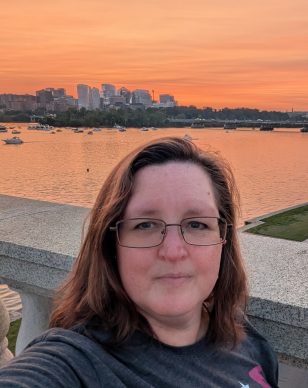
Trina Caudle
In both high school and college, I wrote for my campus newspaper. I was always the news section editor because I wasn’t afraid to talk to the superintendent or the university president to get the heavier stories. I just asked a lot of questions. My university didn’t have a journalism major, so my degree is that I put together a weird composite of history, journalism, and oddly enough, political science. I had never intended to work in government, but it opened a door to the job I started two weeks after graduation with the Oregon state legislature. I did the minutes of the House of Representatives floor debates – every speech, every reply, all the roll call votes. From there, I moved to Washington, DC in 2003 to work for a states advocacy group called the National Conference of State Legislatures.
I intended to come to DC for a year, and then I would go back to Oregon, but I met my husband six days later. I never moved back to Oregon, we’ve been on the East Coast ever since.
As you were figuring out how you wanted to be in the world, how did your faith travel with you?
I grew up as a good little Mormon girl who didn’t rock the boat. The only thing I was not happy about was my brothers got to go camping all the time with Scouts, and I did not. When I was 18, nobody I knew took higher education seriously – college for girls was only until you got married. So I didn’t take education seriously. I worked a minimum wage job and just hung out with friends. Fortunately for me, a young adult branch was created in my stake and it was a bunch of 18 to 21 year olds getting ready for missions. I went with the wave and served a mission in California right when I turned 21, which was the age limit at the time. It was common to assume sister missionaries served only because they “couldn’t” get married but really, a lot of women served because they chose to be there and we did really good work.
Were there key moments that you can recall, or was it gradual to go from somebody who doesn’t rock the boat to somebody who does?
In my faith and my church participation, I don’t think I rocked the boat much. I did what I was told. Every now and then, I’d pop off about something in a calling, like when I got annoyed enough to start day camp for Primary girls in my stake. The Young Men and Primary boys had all the Scout activities, the Young Women had Girls Camp, but the Primary girls had literally nothing all summer. That was not okay with me. But honestly, nothing really turned my head until I was married, I’d had 1,700 callings, and I had five children. Then I had my moment of, “Wait a minute.”
That moment was when my oldest daughter was baptized. Ten minutes after she’d gotten out of the font, we were listening to the talk on the Holy Ghost. In the middle of it, she turned to her dad and whispered, “So when do I get to pass the sacrament?” It was completely out of the blue. Adam and I looked at each other with an “Oh crap” expression. I wanted to tell her, “You don’t get to do that, but instead you get to …” and I had nothing. I was 41 years old, and that was the first time I questioned anything. I spent that entire summer studying the history of the Relief Society. What do women DO in this church?
What did that questioning lead to?
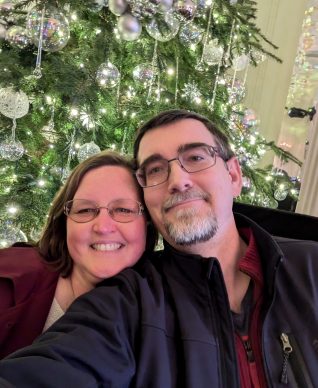
Trina Caudle & Her Husband
Where I landed at that point, and I still hold to, is that in the Church, there’s a difference between minister and AD-minister. For the record, this was a few years before the change from home/visiting teaching to ministering, so I was – ha ha – “ahead of The Brethren.” Anyway, administering is planning, logistics, who can sign the check. It’s management. I kind of settled myself with administering being done by the men – fine, whatever, those are their chores. I have other chores.
Ministering is one-to-one working with people, serving people, loving people. It’s the relationship building that can be done by anyone, and it’s what Christ Himself did. How many times in the scriptures is He talking about scheduling the building or deciding who gets what calling? He’s not. The stories about Christ are about direct interactions with people: supporting them, teaching them, uplifting them, telling them they have value.
That’s where I have focused my faith journey. A few years ago, I was Relief Society president. I was advised by a friend to focus on ministering to people directly and delegate everything else, and I took that literally. I tried really hard to build relationships and help the women work through whatever challenges they had. I commented to my husband once that I could feel my testimony shrinking at the same time it was growing. It was shrinking relating to things like the Word of Wisdom or tithing – those things became less and less important to me. I cared about people, individually, a lot more than any teaching or policy.
The clearest example of the contrast was that I was told by the bishop that I could not call on a specific woman to teach or pray, and she couldn’t have a calling or ministering assignment. She was under church discipline for something, of course I never knew what. The more I was around her, the more I thought – why are we preventing this woman from serving during her repentance process? Wouldn’t it help her to have a ministering assignment? Wouldn’t it help her repentance to attend the temple? If you want someone to draw closer to God, why are we blocking them from the things that we teach that do that? The bishop was not withholding these things from her to be mean, he was (is) very good friends with her, and he was following the Handbook. But the entire situation was so bizarre to me. That’s what I mean when I say I don’t care about the policy checkboxes, and I care more about people as people.
How do you navigate seasons when faith feels quieter or harder?
I take a lot of walks. I feel very connected to God in nature. Two of my kids have special-needs issues, so for a long time I went to Young Women’s camp every year, no matter what other calling I had. I was doing the camp leaders a favor, taking care of meltdowns so they didn’t have to. Now I’m a Scoutmaster of a girls troop in Scouting America (the new name for Boy Scouts) and I go camping every month. When I come home from being outside, Adam comments that I’m a lot calmer and more centered. The calming is as noticeable and dramatic as if I’d just been to the temple.
How do you hold complexity as part of your identity as an LDS woman?
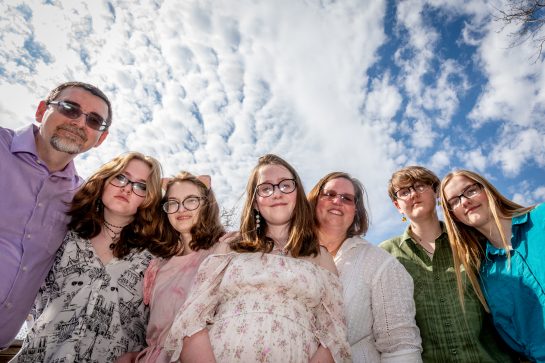
Trina Caudle and Her Family
I don’t think of myself as a complex person. What you see is what you get. I find myself in complex situations, but I don’t think of myself as a particularly complex person. Some of the complex situations are that I have an LGBT child in the LDS Church. I have an autistic child who needs extra community services. My marriage is evolving to mixed-faith because my husband is not believing the same things he used to. But when dealing with all of the complexity, it comes down to – what is my relationship with each of these people? What is your relationship with the people in complex situations around you? Look at people as whole beings, not only gay, or only in/out of the Church, or only whatever. It doesn’t have to be super complicated.
My husband, with all of his religious questions, is still a brilliant and generous person. My LGBT kid, before and after they came out, is a theater nerd and can tell you anything about Greek mythology. My autistic kid says the most hilarious things, wants only books for Christmas, and loves to swim. Whole beings. Lots of ways to interact with them.
What you’re saying reminds me of that quote from President Monson that people are to be loved, not a problem to be solved.
For real. People are people. They’re not problems. They need to be loved, not solved. Like, when people are inactive, people get contacted by the church. It’s like, are you contacting them because you care about them? If you feel caring towards them, do you actually know them? Or are you contacting them because they’re on your checklist?
The only time I ever activated anybody was when I did not bring up the Church. She knew I was a Relief Society counselor. She knew that’s how I’d gotten her phone number in the first place. There was no mystery that I was there to invite her to church. But I just said, “Hey, a bunch of friends are getting together to do this activity. Come with us!” She came back to church on her own, because I was her friend with no pressure. I didn’t turn her into a project and drop her when she didn’t come back right away.
I’m seeing a theme in this conversation of relationships and how center they are for you, and how they drive so much about what you do. Using ministering as an example, there’s something that you seem to have figured out that is a sticking place for many people, including me. How do we move from the checkbox/task to the person?
Sure, it starts as a checkbox. But when you contact them, don’t approach them as a checkbox. When the COVID shutdown happened, we called literally every single phone number on the ward list, didn’t matter if they had a “do not contact” note. The people that I talked to, and I also heard back reports, we said, “Hey, we’re calling from the church and you’re on our roster. Obviously, I’m not inviting you to church because that’s closed down for now, but just checking in. Have you lost your job? Do you need food? Do you need anything?” We didn’t reactivate anybody that I remember, but people appreciated the phone call. They said, “I’m fine. I don’t need anything. Please keep me on the do not contact list. But thank you for showing concern in this time of national trauma.”
You could start with, “I’m calling you because I’m the new Relief Society president, and I’m trying to meet people.” I said, “I’m the new Relief Society president” the entire time I had the calling. I would invite them to lunch or get ice cream and just talk to get to know them.
You’ve done a lot of work with the Cherish books and the Heavenly Mother movement within the Church. I’d like to hear more about your relationship with Heavenly Mother.
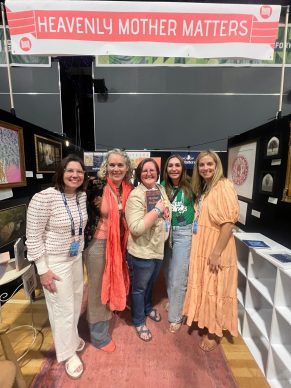
Heavenly Mother Matters & Cherish 3 Book
I grew up with the teaching, myth, story, whatever, that we don’t talk about Her because She’s too sacred. I didn’t question it and just went on my way.
I didn’t have any experiences with Heavenly Mother until the Covid pandemic. I give President Nelson credit for this, because the week after I was called to be Relief Society president, he gave his talk in the women’s meeting called “Spiritual Treasures.” (October 2019) He talked about women having the priesthood through the endowment and gave us homework: go home and study these sections of the Doctrine & Covenants. I was terrified of the calling, so I went home and I studied the daylights out of all those scriptures. Then we had the pandemic, and that narrowed my focus even further into relationship, relationship, relationship.
I was also thinking about my relationship with my husband and what it means to be an eternal couple. One day on Instagram, I came across Rose Datoc Dall’s painting Worlds Without Number, which depicts Heavenly Father and Heavenly Mother together. It stopped me cold. I still don’t have words for it, but that is what I’m working for with my husband. I saved the picture and started following her account. Other Heavenly Mother art kept popping up because of algorithms, and one day someone asked in a question box: “How did you seek for Heavenly Mother?” I looked at that and thought, “Huh. How did I seek Heavenly Mother? I didn’t. She just showed up.”
Everything clicked. Ooohhhh. I didn’t seek for Her. She came looking for me.
About six months later, McArthur Krishna posted a call for submissions for poetry for a book she was starting with Ashli Carnicelli. I had been working with Richard Ostler on his Listen, Learn & Love books for two years at that point so I knew the editing process for full length books. I sent McArthur a message, “I don’t write poetry but I can put your book together.” In less than five minutes, my phone rang and that was it.
God will find you where you are. When God the Mother found me where I was, it was on social media.
You’ve had conversations with more than fifty women in your role as Interview Editor at the LDS Women Project. As you have listened to all of these women and their perspectives, how has that informed the way you show up as a Latter-day Saint woman?
I don’t know that it informs how I show up as an LDS woman so much as I’m showing up as myself. This is me, it’s what I do, it’s how my brain works. It brings me back to the beginning – a writer of real stories, interview skills from my campus newspaper time, and all these interviews are mini biographies! I love talking to people because, at the risk of sounding like a broken record, everyone is so different. They have different interests. They have different capacities. And you accept people as they are. You care about who they are and where they are and what they do. It’s the only way.
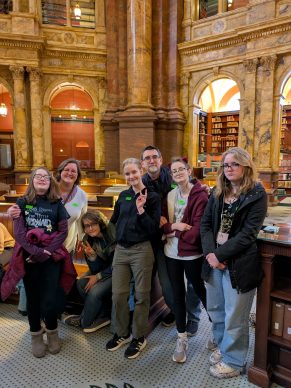
Trina Caudle and Her Family
The American political drama of rejecting the word diversity is the stupidest thing I have ever heard, because we’re not clones. Diversity is everything. I read a book about nature that talked about plant diversity in your front yard – golf-course grass takes a lot of effort to maintain because it’s not healthy. You need at least five to ten different types of plants, flowers, ground cover to even start to have a healthy ecosystem in your yard.
It’s the same with people. I hit a lot of the LDS woman stereotypes: I am a stay-at-home mom. We are a single-income family. I have five kids. I bake bread. I sew quilts. I homeschooled for a long time. I quit my career when I had my first baby because I was taught that this is the right thing to do and having a career is wrong. Now I would go back to full-time work if I could, but my special-needs kids preclude that.
I know another stay-at-home mom of five with a special-needs child, who also bakes bread and sews quilts, is in the Relief Society presidency and goes to Girls Camp … she hits the exact same list of stereotypes. But we have really different personalities, interests, and hobbies. Diversity. There are as many paths to return to our Heavenly Parents as there are people. The journey to heaven is not a single-file line. It’s not healthy, and it’s not even possible.
What I hope to do through the LDS Women Project, and how I choose to interact with the world, is to acknowledge the infinite ways of living the gospel and recognize everybody’s different talents and skills and interests. I want to celebrate the beauty in diversity.
And Christ and the building of Zion are in that diversity.
That was what I wanted as Relief Society president. My theme word was Zion, one heart and one mind. That does not mean one life and one path. It means we have a common goal. We’re all working toward the same thing. I hope what we’re working toward is living together in peace and harmony and love and acceptance, not personal suppression and conformity.
What would you say to LDS women who may feel unseen or unheard or unsure of their place?
That is a valid feeling. They very well could be unseen and unheard, and they might not have a place. You can’t belong your way into a group of people. I’ve tried it more than once in church and non-church situations, and it doesn’t work. I’m very aware, for example, that many LGBT people would love nothing more than to belong in the LDS Church. But they don’t, because the people around them will not accept them or allow them to belong.
Belonging comes from outside one’s self. It is external, not internal. I can contort my personality and behaviors into whatever is “acceptable” to try to fit in, but unless I’m accepted for myself as I am, I do not belong. Belonging only comes from other people.
For the women who do not feel that they belong, they might not. In which case, I hope that they will create belonging for other people. If you feel like you don’t belong, go look for somebody else who also doesn’t belong, and belong to each other.
If you are in the center of the ward or whatever social circle, you need to know that you control whether or not another person belongs. Your reaction and acceptance is what helps them belong, or not. Being in the center is great for you, but other people are out on the fringe. It is your responsibility to bring them into the center. They cannot force their way in. You have to let them in.
AT A GLANCE
NAME: Trina Caudle
AGE: 53
LOCATION: Northern Virginia
MARITAL HISTORY: 22 years and counting
CHILDREN: Five creatives
CONVERT TO THE CHURCH?: Born and raised
EDUCATION: Western Oregon University
OCCUPATION: Editor and writer, Scoutmaster, road trip driver
LANGUAGE SPOKEN AT HOME: American teenager – skibidi!
FAVORITE HYMN: I’m Trying To Be Like Jesus
SOCIAL: Instagram @libraryhouseediting
At A Glance
Produced by Elizabeth Ostler